Unity in Diversity – Incredible India
India is a land of unity in diversity. It is the seventh-largest country in the world and has the second-largest population. India is surrounded by water on three sides — the Bay of Bengal in the east, the Arabian Sea in the west, and the Indian Ocean in the south.
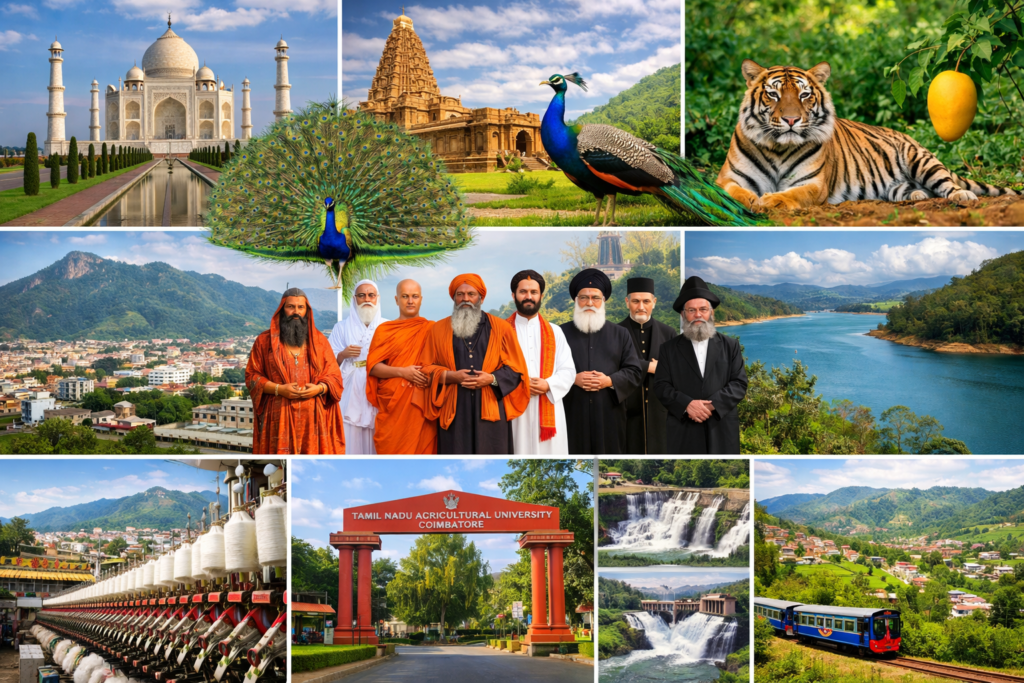
The Tiger is the national animal, the Peacock is the national bird, and the Mango is the national fruit of India. People of many religions such as Hinduism, Buddhism, Jainism, Sikhism, Islam, Christianity, and Judaism have lived together peacefully in India since ancient times.
India is rich in monuments, temples, tombs, churches, museums, historical buildings, wildlife sanctuaries, and scenic landscapes. It is also the birthplace of many great leaders and freedom fighters who shaped the nation’s history.
10 Interesting Facts About India
Chess was invented in India.
Algebra, Trigonometry, and Calculus originated in India.
The Place Value System and Decimal System were developed in India around 100 B.C.
The Brihadeeswara Temple in Tamil Nadu is the world’s first granite temple, built during the reign of Rajaraja Chola.
India is the largest democracy in the world and one of the oldest civilizations.
Ayurveda is the earliest known system of medicine; Charaka organized it over 2,500 years ago.
The value of π (pi) was first calculated by Aryabhata.
The concept related to the Pythagorean Theorem was known in India long before others.
Hinduism, Buddhism, Jainism, and Sikhism were born in India and are followed by nearly 25% of the world’s population.
India has rich biodiversity with about 90,000 animal species, 1,200 bird species, and 50,000 plant species.
Conclusion
India truly deserves the title “A Country of Unity in Diversity.” Despite differences in language, culture, religion, and traditions, Indians live together in harmony, making India one of the most unique and fascinating nations in the world.
About Coimbatore
Coimbatore is the second-largest city in Tamil Nadu after Chennai and the sixteenth-largest urban agglomeration in India, with a population of more than 50 lakhs. There are over 30,000 small, medium, and large-scale industries and textile mills. The city is known for the entrepreneurial spirit of its residents, and the climate is pleasant throughout the year.
The city is situated on the banks of the River Noyyal. Coimbatore existed even before the 2nd Century AD as a small tribal village called Kongunad until it was brought under Chola control in the 2nd or 3rd Century AD by Karikalan, the first of the early Cholas. When Kongunad fell under British rule, its name was changed to Coimbatore. In Tamil, the city is known as Kovai.
Coimbatore is famous for the manufacture of motor pump sets and various engineering goods, earning it the title “Detroit of South India.” The development of hydroelectric power from the Pykara Falls in the 1930s led to a cotton boom in Coimbatore. As a result, the city gained a strong economy and a reputation as one of the leading industrial cities in South India.
The city is also known for its educational institutions. Tamil Nadu Agricultural University is recognized as one of the best universities of its kind in South Asia. Despite industrial and technological growth, traditions and age-old customs are still held in high esteem. The temples reflect the people’s devotion and love for art and architecture. There are also several tourist attractions near Coimbatore. Udagamandalam (Ooty) is one of the most popular tourist destinations in India.